
GREEN WORLD
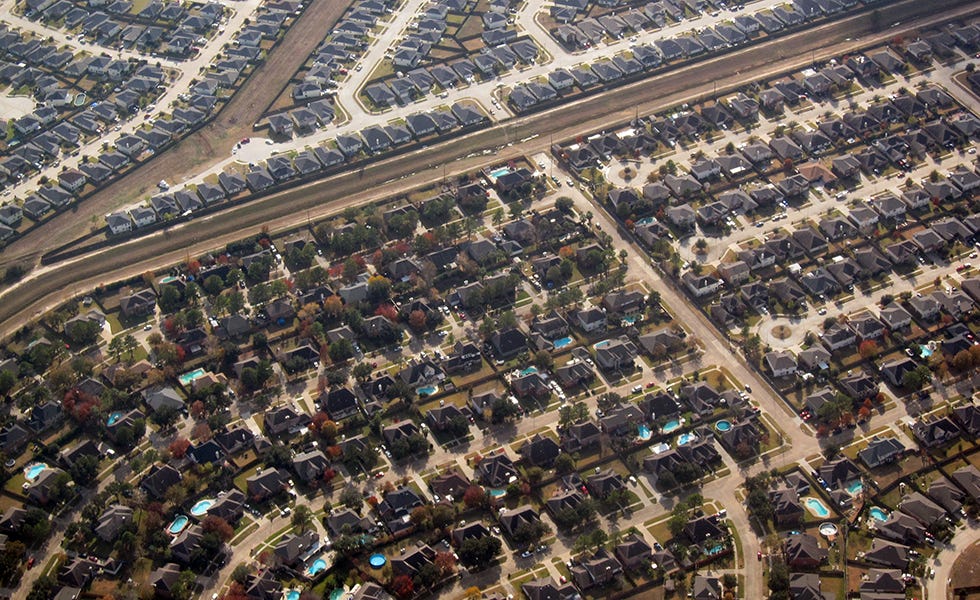
When I imagine growing up in the suburbs I think of an expanse of green. There’s grass everywhere and trees of all varieties. There’s deliberately set aside “Open Space” who’s designation as such says less about the present and more about some future negation (home’s have to be built somewhere after all). These green spaces are not just public (what’s “public” is always examined with some skepticism in the suburbs) but private as well. The grass existing in smaller forms in backyards and front lawns, the trees finding homes in planters and atriums, to be uprooted to install built-in grills and pools. The sense of being in Nature is cultivated, but so is the idea that it’s less the natural state of the world and more an idea that can be brought up when necessary to justify the opposite. The suburbs are a green world, some place imaginary, that exists because of very real questionable decisions. And more than anything it’s loud.
Before coming back home I thought of an expanse of green because I think that’s what you’re supposed to remember from growing up in a suburb. The hugely marketable idyll. That or the good schools. But the experience of the suburbs is noise. Not from cars (the relationship with cars is complex, to be close to the street is to lose, to not have the car you’re supposed to have is also to lose, to drive is annoying, but to not be able to do it is worse) but rather the variety of systems that have to be engaged with to maintain all the greenery. There’s the sprinklers for one, a thin layer of PVC tubing running under basically anything a human will see, occasionally rupturing soil to spray water over hungry, unnaturally verdant plants. But there’s also an army of gardeners, contracted by the city and homeowners to mow lawns, trim trees and blow leaves. All things that collapse into the dull roar of a gas engine, a constant hum that’s only rivaled by almost omnipresent construction converting homes designed for university employees into homes designed for foreign investors and med tech entrepreneurs.
The suburbs sell an image of peace, safety and serenity at the cost of most of those very qualities. I’d like to write off that irony as being “very California” but I think you’ll find the same story in any American suburb. It comes to mind only because, as I write this it’s very loud outside (gardeners, nail guns or the small flock of birds who live in my backyard, they are a symphony) and with the current uprisings and pandemic the rhetoric of “the suburb” has been deployed in media old and new and even the federal government as a goal for law enforcement and civic services in general, which in the most charitable sense I understand (“they’d be suburbs for everyone, not just the wealthy and/or white”) but I don’t think bares out. As smarter people than me have said, “the social is predicated on its exclusions”. In the case of the suburbs, the close knit, well-serviced community that the suburbs sell exists BECAUSE a group of people decided to exclude specific other groups of people and hoard their wealth. A more equitable society wouldn’t look like a suburb, it would probably look like a metropolitan city with ample public housing, fair workplaces and no law enforcement. However we’ll never know if the same tired rhetoric is pushed again and again to people who know better and others who don’t care. Or the earth burns. Only one is guaranteed to happen.
HELL IS A PROFESSIONAL YACHT
BELOW DECK is a Bravo tv show. Bravo is a network under the broader NBCUniversal umbrella, which is an entertainment conglomerate owned by Comcast, which is an internet/phone company. All of these might all exist under different corporate nomenclature by now. I'm not paid to keep track of that. BELOW DECK is nominally a reality tv show about the exploits of the crew of a chartered yacht, their experience serving bizarro rich (but like, in a trashy way) guests and their conflicts with each other. To start, it’s instantly compelling. Like most tv shows that spark for me it has the opportunity for obvious episodic structure. The typical yacht charter lasts 2-3 days which with intelligent editing can handily fit into a single 45-48 minute episode of television. In this way the show can “play the hits” of a typical reality tv show narrative, fitting in mid-roll goofs and even the post-charter drunken come down, while wrapping things up and moving on to the next flavor by the next episode. It’s also just enough to time to construct vague, but compelling personal narratives for the crew members, even if it’s as simple as not being as much of an asshole to coworkers. With the firm hand of that initial structure, it's easy to slip into the kind of binge that Netflix loses their mind over. Episodes fly by and you get to appreciate the weird little nuances and procedures of professional yachting.
If you’ve worked in food service, hospitality or customer service you’ve more than likely thought “someone should make a show about this”. If you didn’t think it, than likely a coworker did and they told you about it. The indignities suffered serving unkind, paying customers is not dissimilar from those suffered in a tragedy or even the purplest of dramas. We’re taught from a young age in the United States to not really view the people who serve us in the context of their humanity, but rather as a kind of product. We claim to enjoy that friendly, home-y feeling, but we don’t want mistakes and we get mad when we don’t receive what we believe we deserve based off how much we’ve paid. When you’re here you’re family and the cost will equal the service or else. BELOW DECK, while featuring all the usual contrived reality tv drama that editing, nimble producers and plied alcohol can provide, realistically captures the ridiculous expectations and profound mistreatment that “clients” foist upon the workers serving them. Perhaps most troubling on this show, how lewd comments from guests, typically directed at female members of the staff, are brushed off in the pursuit of a bigger tip. Occasionally things boil over, but the squashing of real feelings that regularly happens on the show and in hospitality and services jobs across the country is captured in all its disappointing glory. The song remains the same, even on a luxury yacht in the Bahamas.
Approaching almost five seasons of watching this show (my hopes for the future are grim) it's hard to find the initial intrigue or even joy that characterized those first few episodes. BELOW DECK is all the luxury hell that one associates with hotels or AirBnBs, but made mobile, forced to roam recently (in the grand scheme of history) colonized land, re-enacting the worst bits of culture back home in the small confines of a “white boat”. Outside of a vague desire to have something playing in the background while I play games on my phone (my brother has suggested this is like a “podcast”) I think the main reason I continue to watch is that some part of me enjoys re-traumatizing myself with the pains of the service industry. Solidarity is a feeling strongly lacking in most people's lives whether they realize it or not and even though many of the subjects of this reality show happily hold up and perpetuate the system exploiting them, I feel a small amount of solidarity with their struggle.
I fear what happens when I run out of episodes. I'm working my way through the Mediterranean spin-off. It's somehow worse? I don't know how they managed that.
TALKING TO PEOPLE IS HARD
I try to stay abreast of great independent video game releases because 1) that's where the form ACTUALLY gets innovated and built upon and 2) as the newly minted Games Co-Editor for the good ship Merry-Go-Round Magazine , somebody's gotta do it (this is not a paid position). Since the heat surrounding Animal Crossing New Horizons has cooled, I'd like to direct you, newly minted "gamer" in need of a good time, to Signs of the Sojourner. I covered the game for Merry-Go-Round's write-up on the Bundle for Racial Justice and Equality which you can read here but I'd like to excerpt what I wrote, because I've continued to think about the game and I think it's worth expanding:
We take for granted that most people we interact with on a day-to-day basis are like-minded and largely understand everything we say to them. We come from the same place and we say the same kinds of things. But what happens when that’s no longer the case? What happens when you lack the words or even common understanding to get your point across? How does it feel when you can see someone’s understanding of you slipping away as they write you off, knowing you could never understand their plight even as you try your hardest to? SIGNS OF THE SOJOURNER, created by the folks at Echodog Games, captures all that through the unusual gameplay of the now popular deck-building genre. SOJOURNER follows a traveling merchant character as they attempt to collect merchandise for their general store. They’re armed with a truck, a willingness to talk to people (and eventually a very cute dog), and they explore a post-collapse landmass, some mix of MAD MAX desert and ORYX AND CRAKE biome run amok, learning about their past and collecting merchandise. The game introduces its main conversation card game initially as a way to mediate a conflict between two friends, requiring the matching of symbols (at first just signifying empathy or logic) to pass through segments of a conversation with “agreements” (signified by grey squares) rather than “disagreements” (signified with black squares) that cause the conversation to fall apart. Quickly this set of mechanics is complicated with the introduction of other types of symbols and additional traits that can be applied to cards, allowing you to “Clarify” past cards played, “Chatter” to the unique cast of characters, laying an extra card per turn, or even “Accommodating” them by allowing them to explain themselves with additional cards. There are other systems to manage beyond that, a caravan that you can travel with or ignore to pursue your interests, a calendar with events that you can attend or miss entirely, and a narrative that weaves together labor movements, community building, and multiple character’s relationships to their own pasts. What stands out the strongest are those moments of disagreement. Knowing you don’t have the “language” or “experience” to understand a character but trying to anyways on the off chance they might just have something they can reference to bring the conversation back on even ground. Many games feature branching narratives influenced by NPC’s opinions of the player character, but few capture the nuance of conversation and the intense emotions that can come with being understood like SIGNS OF THE SOJOURNER. It’s a game quite unlike any other and in a bundle full of wonderful games, it’s well worth setting aside some time to check out.
That failure is such a large component of the game is telling. Relating to people is not easy. We have our moments with our loved ones, but there's always a misunderstanding coming down the pike. Something to upset the bridges of understanding we carefully construct over time to reach people, understand them, convince them and console them. What makes Signs of the Sojourner so exciting is that sensation, the fear, frustration and excitement of communicating is captured almost wholly in the gameplay rather than just the dialogue the characters share with each other. It's an important reminder that narrative design is not just the text and the timing of its delivery, but also how the player experiences it, how the game has digested it and the things you can do in the space between what's written and what's implied to tell your own story.
You can purchase Signs of the Sojourner here.
THE SUMMER WE NEVER HAD
Do you like music? I think it's alright. I've made it a habit of making a playlist of summerjams (spelling intentional) every year. Essentially the songs I feel capture the mood of that year's summer, whether it's sad, happy or somewhere in between. I've been putting off this year's for many reasons. There's the immediate problem, a raging pandemic means that most people won't be doing the traditional activities we associate with summer. The beach days, barbecues, house parties, drinks and late night movies that used to make up my summers are out of the question and really should be for most people concerned about the safety of their community. And there's also the adjacent problems, I lost my job and I moved back in with my parents. But there's a broader, more abstract reason too, the pandemic has confirmed a feeling I had already started to feel: that the horizon of a happy, gainfully employed extended adolescences that many of us are get to experience is fading into the distance for me. I'm standing on the shore watching it go, tangled in all the things out of my control (the awful world I was gifted upon birth and a terrible government on almost all levels) and in my control (my film degree, my lack of internships, my reluctance to form mutually beneficial social bonds, the list can go on). So summer as I've known it feels both irresponsible and increasingly impossible.
But in the spirit of this newsletter, imagining other ways of being and other outcomes for sad lives, I've made a playlist anyways. It's a work in progress as these often are, but I think I'm finally happy with a majority of the songs on it. The premise is simply "if this were all to end right now, the pandemic, US imperialism, hell capitalism itself, what's the smallest sliver of stuff you'd like to sweat, cry and move to at the first party of the rest of your life"? This playlist is a start.
NO SHAME
That's right! I'm unemployed and concerned about the future. If you or someone you know is hiring I'd love to try my hand at applying. My background is in sales, customer service and leadership, but I studied writing in school, had a brief tenure as a development intern, edit for an online magazine and have spent the last three years or so learning podcast production and some quick and dirty HTML and Javascript. Normally I feel a little gross and dejected asking about these kinds of things because they're always a shot in the dark, but quite literally the world is ending and I want to be able to afford a raft.
And that's the newsletter! I intended to have something out sooner but life happened. Stay safe, stay inside if you can and do what you can to help the people closest to you (geographically). You vote every two to four years, but you live every day and the things you can do today will ALWAYS matter more than who wins an election. Even just handing out water or food to an unhoused neighbor is worth so much more to them and you than how ashamed your parents feel about the president! Seriously!
P.S. sorry this one was light on visuals, really just wanted to finish